
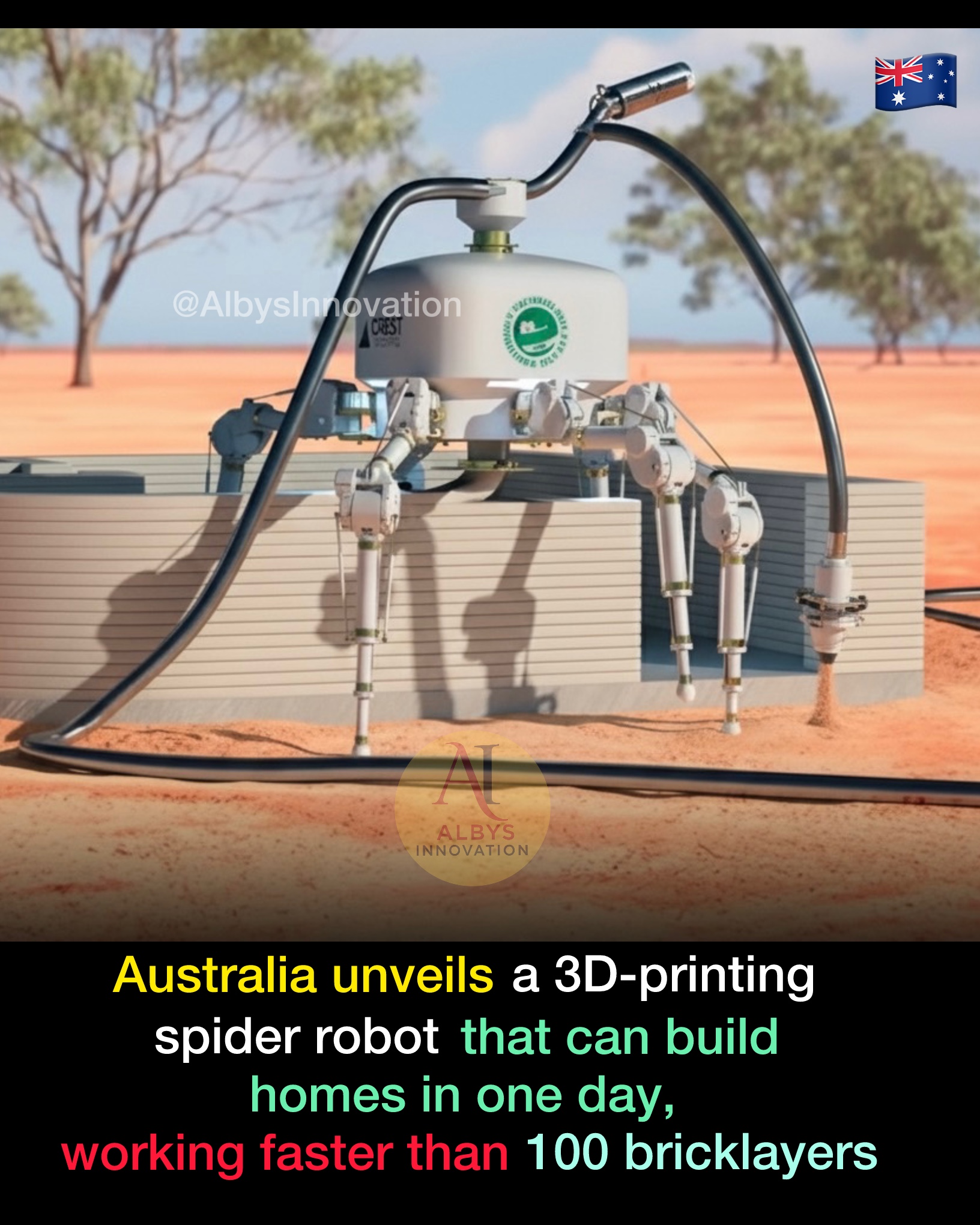
The discovery of a 3D-printing spider robot that can make an entire house in a single day has ushered in a new age of technology in the construction industry in Australia.
The creation of Australian robotics designers and architects, this autonomous robot integrates the artificial intelligence, 3D printing, and biomimicry - based on the agility and precision of a spider. It is able to operate 24 hours a day and print in every direction, approximately more than 100 human bricklayers.
A Revolution in construction starts.
The robot (Hadrian X) was set to address one of the largest issues in housing today speediness and workforce deficiency. Conventional methods of home construction take the months of construction, dozens of people work on the construction, and it is strongly reliant on manual labor.
This spider robot alters this equation completely. It can print the base, walls and the simple structural components of a house in a short time of less than 24 hours using sophisticated 3D printing nozzles and self adjusting arms.
How the Spider Robot Works
The design of the robot is based on the fact that spiders have 360 degree rotational mobility which enables the robot to navigate around a construction site without scaffoldings. It employs a computer-controlled precision mapping which layer by layer pours concrete or ecological composite material.
After the design is posted, the robot takes it up all by itself, not only in computing measurements and printing out complex walls, insulation channels and even plumbing and wiring conduits.
Faster Than 100 Bricklayers
The proponents of the project expect the robot to have the capacity to lay the equivalent of 1,000 bricks in one hour and say the work of a large team of human workers that would require several weeks was accomplished in a day.
This productivity does not only lessen working hours, but it also minimizes expenses, materials wastage and environmental effects through an accurate deposition of materials.
Constructed to be Eco-friendly and Green.
The spider robot incorporates low carbon concrete that is composed of recycled materials and mixes it on site to minimize wastage. It works on renewable sources of energy too, which is in line with the sustainable construction of Australia.
This system is fast and eco friendly in comparison to the conventional methods where the waste of materials is cut down by up to 60 percent and carbon emissions are cut down by half.
Developed to work in Harsh Environments.
The spider robot is constructed to withstand tough environments - in city and in rough terrain. It is capable of working in the heat, wind, or light rain and control its movement with the help of the AI-powered stability sensors.
This is the best feature of it because it can be used in emergency housing projects, disaster recovery and affordable housing projects.
Artificial Intelligence Accuracy and Self-training.
The robot is also fitted with artificial intelligence making it learn as it does every project. It is more precise, terrain adaptable and corrects small deviations automatically.
It can determine its position using lidar sensors, cameras, and GPS and it can also mass-cut down on time and material by optimum printing paths.
A Remedy to the Shortage of Housing.
The construction industry is experiencing massive housing demands globally, and this innovation can be used to address one of the major crises that are facing the world, which is affordable housing. The prospect of low-income communities, refugees, and disaster relief being provided with a technology essential in the creation of strong, secure homes quickly renders this technology essential to the community.
Governments and non-governmental organizations already discuss the way that armies of such robots can be sent to construct whole neighborhoods in days, not months.
Safety and Accuracy
Human intervention is minimal because the spider robot is autonomous and therefore only requires human control and programming. This reduces accidents at the work place and also guarantees quality which will not be affected by exhaustion or human error.
Every structure constructed is digitally checked with the architectural model - ensuring precision of a few millimeters.
Cooperation with the Australian Universities.
This is an innovation that has developed due to collaboration between FBR (Fast Brick Robotics) with the large Australian universities. It belongs to a larger Robotics for Infrastructure 2030 Initiative of the nation, which also tries to ensure construction business is safer, quicker, and less eco-unfriendly.
The Rise of “Construction 4.0”
During this new age, houses can be designed online, assembled by robots and can be inhabited in less than a day - and at a lower cost and with less environmental impact.
Outside Homes: Future Uses.
These robots will be utilized by engineers to perform:
• Constructing bridges, schools and hospitals in isolated areas.
• Post-disaster emergency shelter buildings.
• Habitation of the printing space on the Moon or on Mars in the future.
The versatility and strength of 3D-print material are the main reason why it is critical technology in both earth and extraterrestrial construction.
Ending: The Spider That Builds the Future.
Australia has not only revolutionized the field of construction, but it has also changed what can be achieved with the introduction of this 3D-printing spider robot.
A home in a day is no longer a dream, it is a reality that is driven by innovation, intelligence and accuracy of robotics.
The construction of the future is soon, green and robotic, and it is just crawling its way into the past, layer upon layer.