
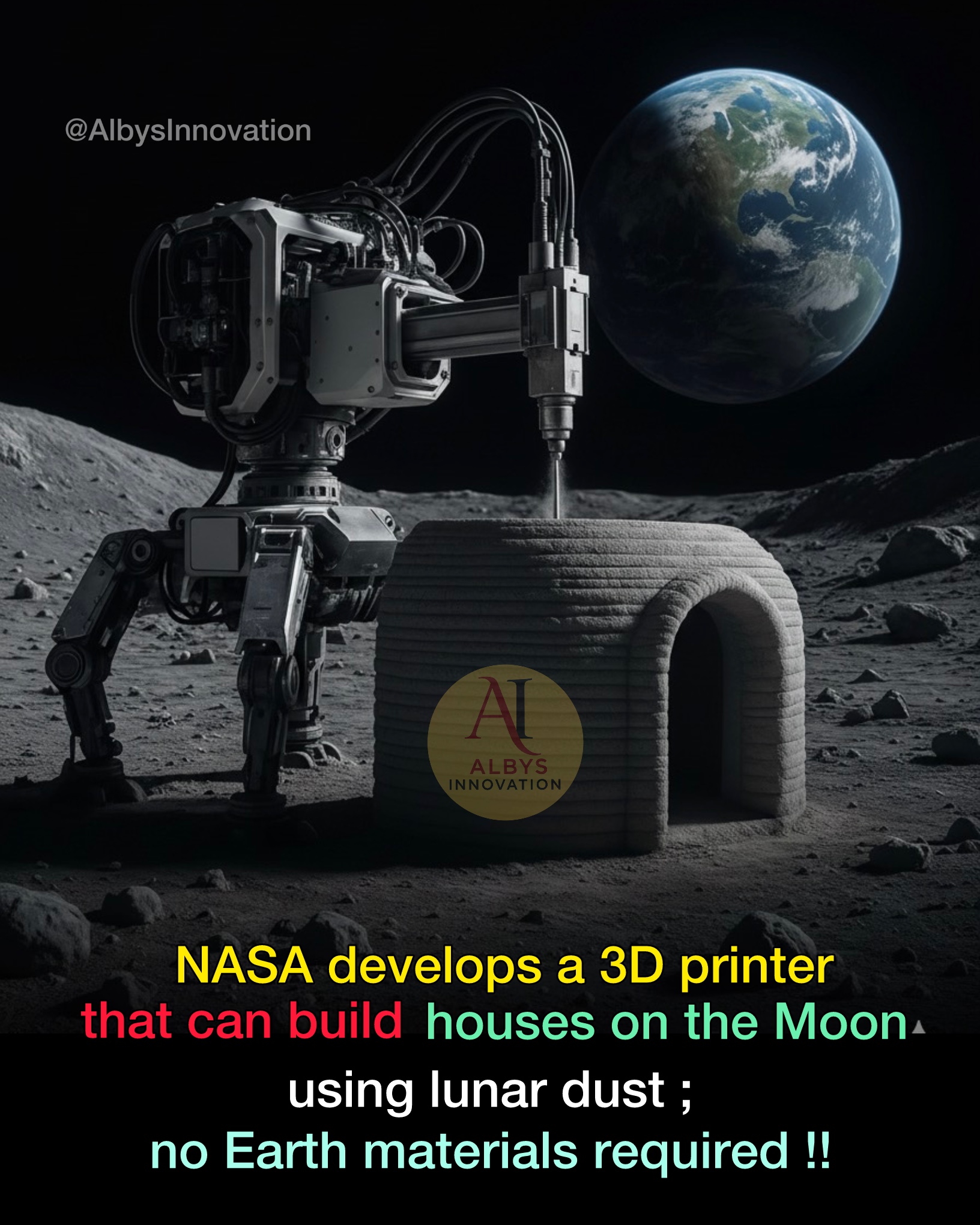
NASA has revealed one of the most revolutionary ideas in the sphere of space exploration the 3D printer that can create houses on the Moon with the help of lunar dust only.
This technology will revolutionize the lives of people in the space and construction there, as people will not bring materials, which are expensive and expensive to transport, to the moon, and this will open the way to the permanent colonization of the moon.
To Build the Future, Literally, on the Moon.
The 3D printing system by NASA, which was developed within the Project Olympus, utilizes advanced lunar regolith (moon dust) as the main building material.
Rather than transporting tons of concrete, steel or bricks to Earth, astronauts will now have an opportunity to print the structures onto the Moon using the materials that are already present on the Moon.
It represents a breakthrough that incorporates robotics, materials science, and 3D construction technology, which will change the off-world habitation.
The Technology of Lunar 3D printing.
Silicates, metals and oxides are present in lunar soil or regolith, which can be melted down in the presence of high temperatures.
The printer at NASA is also based on a combination of microwave and laser sintering, where the dust of the moon is heated until it melts, and then it becomes solid in layers of hard rock-like material, which is essentially a way of transforming dust into building blocks.
Reasons It Matters The Space Construction Problem.
The case of constructing space has never been easy. The cost of transporting construction materials on earth is enormous, one kilogram may cost more than 1 million dollars to get to the moon.
Through the local resources, NASA will be able to reduce the cost of missions and at the same time develop sustainable infrastructure.
With the help of this innovation astronauts are able to produce:
• Landing pads for spacecraft
• Shelters that are protected by radiation.
Storage domes Research equipment storage domes.
How the Printer Works
The 3D printer on the Moon will act independently, with the help of artificial intelligence and robotics.
It is armed with cameras, sensors and manipulators and is able to scan the surface of the moon, gather regolith and add layer after layer with pin point accuracy.
The outcome: complete lunar shelters, the construction of which can be finished in several days, not months, and with a human hand.
Collaborations To the Innovation.
NASA partnered with ICON, a US-based construction-tech firm that is reputable in 3D-printed Earth-based houses. The Vulcan printer by ICON already constructed Mars-like habitats and habitable homes in their Texas premises.
The technology is now being modified to lunar gravity, vacuum conditions and temperatures that are off the scale, plus -170 C and +120 C.
The Construction of Homes to the Astronauts -and Humanity Future.
This technology will also be used to sustain NASA Artemis missions, which will include returning people to the Moon by establishing a permanent lunar base by the year 2030s.
Through constructions with lunar dust, the astronauts would be able to construct habitation before the human beings even set foot on the surface of the moon and then safe shelters could be ready at any time when people travel to the moon.
Sustainability Outside This World.
The lunar 3D printing project is an extension of a bigger objective of NASA of In-Situ Resource Utilization (ISRU) - use of local materials on the celestial bodies to support the life and activities.
It forms the foundation of life off world, as it allows the settlers to live on their own on the Moon, not only that, but on Mars and further on.
The Advantages of Lunar 3D printing.
1. No Earth Materials Required/cost and weight reduction of missions.
2. Independent Construction - even the robots are able to construct without the presence of human beings.
3. Radiation Protection - cosmic ray shielded thick printed walls.
4. Thermal Resistance - buildings withstand high temperatures of the moon.
5. Sustainability- minimum waste, complete reuse of materials.
A Peek into the Future Moon Cities and Beyond.
NASA imagines groups of 3D-printed living places linked together by tunnel networks and solar arrays - miniature cities on the moon where people will be able to live, work and study months at a time.
These will act as stepping stones to Mars missions (lunar 3D printing will be the foundation of interplanetary living).
AI Meets Space Construction
The intelligence system of the printer is capable of adjusting to the new circumstances, searching the environment, and correcting itself during printing.
Depending on either earth remote control or orbit, engineers are able to tell the robot to construct, repair or even enlarge structures without stepping on the Moon at all.
From Earth to Space -The Same Technology Changing Lives Here.
Interestingly, the same 3D printing technology is also being applied on Earth to construct cheap homes in the disaster area and third world nations.
The success of NASA lunar printing can hasten inventions on earth - this will prove that space technology tends to go back and assist humans on earth.
The Future of Human Civilization.
It is not only in the Moon that this milestone in 3D printing was achieved but it is also redefining the ways of settling outside of Earth.
It is the first instance when a human being can afford to make sustainable shelters with just the resources of a different world.
It is a step to interplanetary civilization, in which our homes can be 3D-printed, layer after layer, on alien worlds.
Conclusion: the Future of Space Exploration Printed.
The lunar 3D printer of NASA is a manifestation of something new and unique, sustainable and based on human resourcefulness.
NASA is not merely creating shelters by using lunar dust, but it is creating the future.